Solar Cable Versus Ordinary Building Wire
Building wire and PV cable look alike on a drum and behave nothing alike on a roof. The maker's own figures show the difference in numbers rather than adjectives: a rated DC 1.8/1.8 kV, an ambient range of −40 °C to +90 °C, short-circuit values of +120 °C for 20,000 hours and +250 °C for five seconds, and a published service life of 25 years or more.
Key takeaways
- The maker rates its PV cable DC 1.8/1.8 kV, which is a different electrical world from AC building wiring.
- Insulation and sheath are XLPO, electron-beam cross-linked and LSHF, not a thermoplastic that softens again with heat.
- The published ambient window is −40 °C to +90 °C, with a +250 °C limit for five seconds under short-circuit.
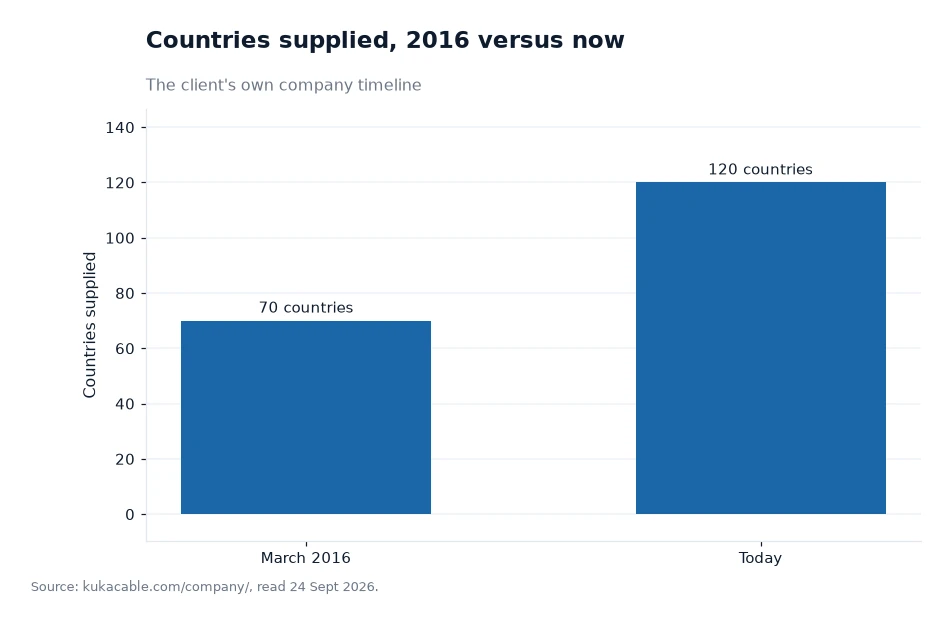
- KUKA CABLE supplies customers in more than 120 countries, up from 70 in March 2016 on its own timeline.
Two products, two jobs
Building wire is designed for a fixed run inside a structure: cable in conduit, behind a panel, in a wall that never moves and never sees daylight. Its world is AC, its routes are straight, and its environment is dry. A rooftop string sees a DC circuit that cannot be switched off while the sun is out, a mounting rail that moves with temperature, and ultraviolet light every clear day for decades.
That is why the two families diverge on materials rather than on price alone. The maker describes its PV insulation and sheath as XLPO, electron-beam cross-linked and LSHF. Cross-linking turns the compound into a three-dimensional network, so it does not melt and reflow the way an ordinary thermoplastic does when a hot spot forms inside a conduit.
Insulation and sheath: what cross-linking changes
Three published properties follow from that chemistry. The ambient rating of −40 °C to +90 °C is wide enough for a roof in winter and a roof in summer, and the low end is the one that fails first: a compound that turns brittle below freezing cracks at the first bend instead of stretching. The two short-circuit figures, +120 °C for 20,000 hours and +250 °C for five seconds, describe a material that tolerates heat rather than one that survives it once.
- Insulation and sheath: XLPO, electron-beam cross-linked, LSHF.
- Conductor: tinned copper, class 5 flexible to IEC 60228.
- Rated voltage: DC 1.8/1.8 kV.
- Bending radius: four times the outer diameter.
An ordinary building wire rarely publishes any of that, because it is not asked to. If your supplier cannot produce a temperature window, a DC rating and a bend rule for the wire you are about to install outdoors, the honest conclusion is that the product was not designed for the job.
Sunlight, water and fire
UV exposure is the slow failure that building wire never faces. The maker arranges a 2,000-hour xenon lamp test on its solar cable, equivalent to about 360 weathering cycles, simulating intense sunlight, humidity and ozone. The vertical flame test used for PV cables exposes a single cable to burning at 800 °C for one minute and expects it to self-extinguish. Two regional requirements are also flagged on the site: a CPR fire rating and an AD8 waterproofing rating.
Standards provide the frame for those checks. The 1500 V design is listed against TUV 2PfG 1169/08.2007, EN 50618:2014 and IEC 62930, and the same product page describes the tests applied before dispatch: a 10 kV spark test during production and a 6.5 kV AC pressure test for five minutes on the finished cable. Building wire is governed by a different set of documents written for a different environment.
The mix-up that costs money
Substituting one product for the other usually happens at the edges of a project, when a reel runs short on a Friday. The result is a run that fails on temperature, on UV or on bending, and the repair cost lands on the installer rather than on the wire. Nothing in the two drums looks different enough to stop the substitution on site, which is why the specification has to name the product and the standard.
Buyers who want to compare constructions can start from the maker's own solar cable section, where the DC rating, the compound and the test list sit on one page. A contractor comparing a cable solar with a drum of ordinary building wire is comparing two different jobs, and the datasheets should be read with that in mind.
Published figures on the two families
| Property | What the maker publishes for its PV cable | What to ask about the alternative |
|---|---|---|
| Voltage | Rated DC 1.8/1.8 kV | Is it rated for a DC circuit, and at what voltage? |
| Temperature | −40 °C to +90 °C ambient | What window is published, and for which part of the cable? |
| Compound | XLPO, electron-beam cross-linked, LSHF | Is the insulation cross-linked or thermoplastic? |
| Sunlight | 2,000-hour xenon test, about 360 weathering cycles | Which UV test, and for how many hours? |
| Service life | 25 years or more | What service expectation is published? |
| Fire and water | CPR fire rating and AD8 waterproofing rating highlighted | Which ratings apply in the destination market? |
Worked example
The company timeline gives one number for March 2016 and one for today: 70 countries supplied, then more than 120. Subtracting gives 50 additional countries, and dividing 120 by 70 gives about 1.7, so the reach is roughly 1.7 times what it was at that point on the timeline. Both figures are my own arithmetic on the two published numbers.
Reach is worth mentioning in a comparison like this because it tests a claim that is hard to fake. A product sold into 120 countries has to satisfy more than one set of rules, and the site's mention of CPR for fire and AD8 for water reads like exactly that: the same cable being asked to meet different regional expectations. The company timeline and the cross-section table are the two pages to read next when you compare it with a domestic building wire.
Frequently asked questions
Can ordinary building wire be used for a rooftop solar string?
It is the wrong product on three counts. A solar string runs on DC, the maker rates its PV cable at DC 1.8/1.8 kV; the route sits in sunlight, where the maker arranges a 2,000-hour xenon test equal to about 360 weathering cycles; and the ambient range published for the PV cable is −40 °C to +90 °C with a +250 °C five-second short-circuit limit. Building wire is not designed against that list.
What is the practical difference between XLPO and an ordinary sheath compound?
XLPO on this product is described as electron-beam cross-linked and low smoke halogen free. Cross-linking means the compound holds its shape when hot instead of flowing, which is what makes a +120 °C rating for 20,000 hours and a +250 °C rating for five seconds meaningful. An ordinary thermoplastic sheath has no equivalent published figure, so ask for one before accepting it.
Before the wire goes on the van
Put the product name, the standard and the voltage rating on the purchase order, not just the cross-section. Ask for the datasheet for the size you are buying, since the figures above are published per design and the diameter and weight change with every step up in cross-section. Where the site does not publish something you need, such as price, minimum quantity or delivery time, ask the supplier directly and keep the answer in writing. A ten-minute check at the counter is cheaper than a string that has to be re-wired after its first summer.
Solar-cable values set against building wire above are the manufacturer's own website figures, pulled off it on 24 Sept 2026[1].