Questions Importers Can Ask About Managing product sampling with suppliers
A supplier sample is useful only when the buyer knows what decision it will support. A design reference, a production-equivalent sample, and a sample drawn from a shipment lot provide different evidence. Importers should define the item and revision, identify acceptance criteria, record the sample’s origin, and agree how findings affect the order before production moves ahead.
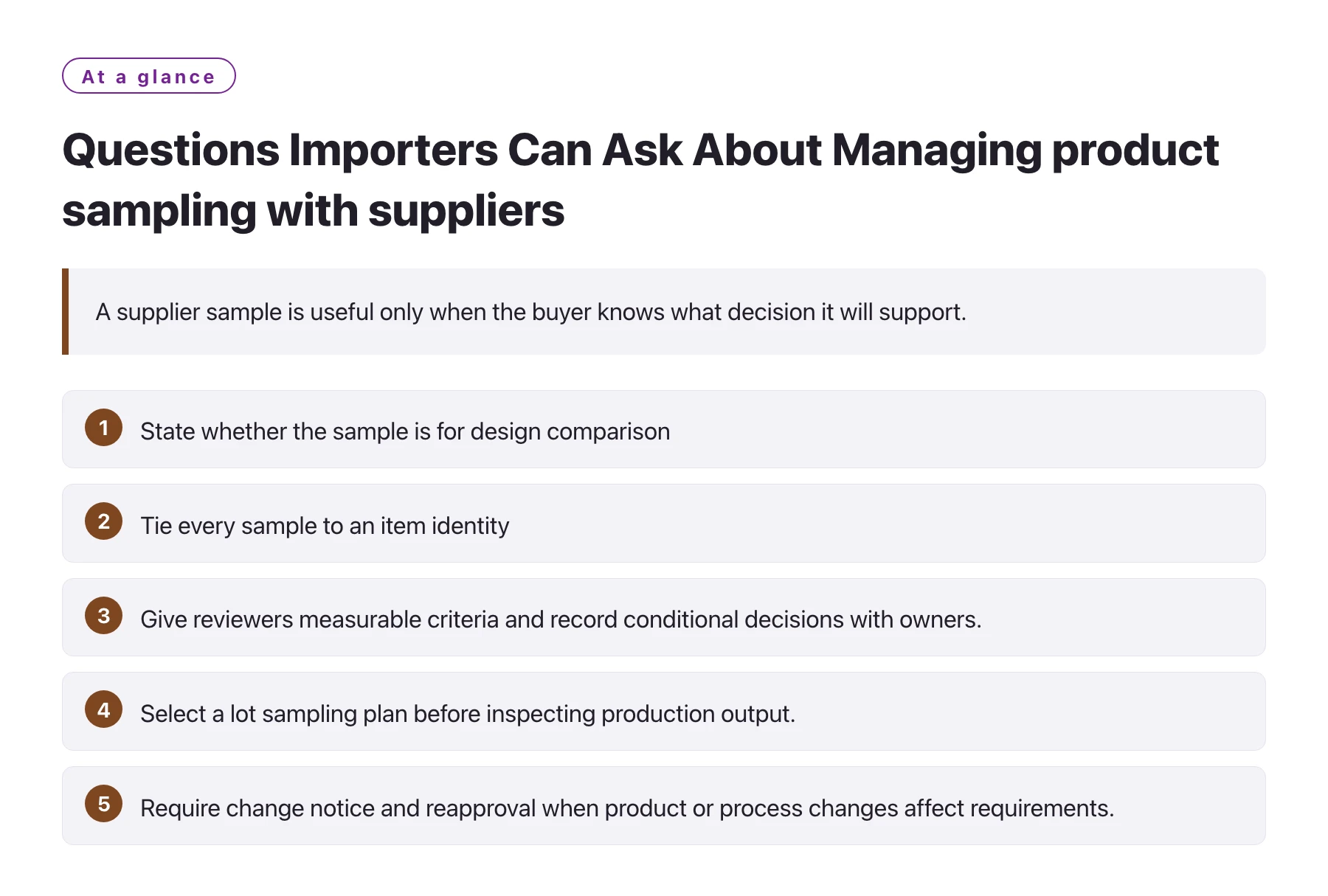
Key takeaways
- State whether the sample is for design comparison, qualification, or lot acceptance.
- Tie every sample to an item identity, revision, source, and review record.
- Give reviewers measurable criteria and record conditional decisions with owners.
- Select a lot sampling plan before inspecting production output.
- Require change notice and reapproval when product or process changes affect requirements.
Sample management is a small process with consequences for cost and schedule. A clear record lets teams compare the object, the written specification, and the production lot without relying on memory. The right level of testing depends on product risk and the question being asked.
What question should the sample answer?
Begin by stating the decision the sample is meant to support. A first sample may help compare a design, material, color, finish, or fit; a pre-production sample may confirm the approved specification and production method; a production sample may provide evidence about a particular lot. These purposes are different. A sample that looks acceptable on a desk may not demonstrate durability, safety, compliance, or consistency across a shipment.
Write the product identity and revision on the request. Include item number, drawing or artwork revision, material, dimensions, finish, packaging, quantity, intended use, and destination market as relevant. If a supplier proposes an alternative, ask for it to be identified as an alternative rather than silently substituting it for the requested sample. Keep the request and response together so reviewers know exactly what they examined.
List the characteristics to evaluate and the method. Visual comparison may suit color or workmanship; measurement may suit dimensions; functional testing may be needed to assess fit or performance. State the tools, conditions, fixtures, and acceptance limits when these affect results. If a test requires specialized equipment or a qualified laboratory, plan that review separately instead of implying an informal visual check covers it.
Who selects and identifies the sample?
Ask the supplier where the sample came from: an existing inventory item, a hand-finished prototype, a pilot line, or routine production. Record the producing facility, date, material lot when available, and any operations performed after manufacture. A hand-selected or specially finished sample can be helpful for design review, but it may not represent ordinary production conditions.
For comparison, use a consistent request across candidate suppliers. Define whether samples must be unbranded, production-equivalent, or made with specified materials. Decide who pays for samples and freight, whether tooling charges apply, how returned samples are handled, and what happens if a sample is delayed or cannot be produced. These commercial details can affect the comparison just as much as the object itself.
When a sample has several parts or variants, label each one and create a short inventory. Photograph both the overall item and critical details. Store physical references under conditions that protect them from fading, moisture, or damage. A reference that changes in storage can create a later dispute about which version was accepted.
How should reviews be organized?
Assign reviewers by expertise. Product, engineering, design, quality, compliance, and purchasing teams may each answer different questions. A single approval checkbox can hide disagreements, so capture separate outcomes when the decision depends on more than one discipline. Give reviewers the same revision, acceptance criteria, and photographs or test results.
Use a review record with the sample ID, requirement, observed result, status, evidence, reviewer, and decision date. Mark requirements as pass, fail, conditional, or not evaluated. A conditional approval needs a named owner, correction, due date, and confirmation step. Do not let “looks good” stand in for agreement on measurements or documents that were not checked.
Where a supplier sample differs from the request, decide whether the difference is acceptable for evaluation only or whether it changes the proposed product. Record the decision and the commercial or technical consequence. If the team accepts an alternative, update the specification and quotation before ordering production so the sample and purchase documents do not describe different items.
What can sampling say about a production lot?
A sample review and a lot acceptance sample answer different questions. A reference sample defines an intended appearance or configuration; a lot sample is selected from a defined production lot to support a release decision. The lot, selection method, number of units, inspection characteristics, and acceptance rule should be agreed before results are known. Otherwise, teams may choose a convenient sample or change the threshold after seeing defects.
NIST describes lot acceptance sampling plans as rules that use a sample to decide whether a lot should be accepted, rejected, or in some plans sampled further.[1] The statistical plan should suit the decision and risk. Sampling can inform lot disposition, but it does not prove every unit is conforming or replace process controls. Have a qualified quality owner select the plan where the consequences of failure are significant.
Keep inspection records tied to the lot and specification revision. Report how units were selected, the actual results, any defects, and the decision. If results fail, contain the lot while the supplier and buyer investigate scope, cause, and correction. Re-sampling should follow a pre-agreed rule; repeated sampling until a pass appears can undermine the decision process.
When is a new sample or reapproval needed?
Require a fresh review when an approved design, material, supplier, process, facility, tool, finish, artwork, or packaging changes in a way that could affect an acceptance requirement. Define which changes need buyer approval and what evidence is enough. Some changes may be documented with a comparison and process records; others may require a new physical sample or testing.
Ask the supplier to identify the change, reason, affected parts and lots, risk assessment, validation evidence, and proposed effective date. Decide whether current inventory can ship and whether old and new versions need separate labels. Update the drawing, purchase order, and approval register so the change does not live only in an email or messaging thread.
When the sample fails, describe the gap with evidence and request a corrective version that addresses it. Keep failed and accepted records distinguishable. A rejected sample can be useful if it is labeled with the reason for rejection; otherwise, a future reviewer may mistake it for the approved standard.
How should sample logistics connect to purchase decisions?
Plan sample timing around quotation review, tooling, production reservations, and shipment milestones. A sample that arrives after production has started may be too late to change the outcome. State who is responsible for courier booking, export paperwork, customs clearance, tracking, and receipt confirmation. For fragile, temperature-sensitive, or regulated products, specify handling conditions and responsible contacts.
Once a sample is approved, cite its ID and revision in the purchase order and inspection plan. Preserve the corresponding report and photographs. At production release, confirm that the supplier has the right approved version and understands any conditions. At final inspection, compare production output to the controlled criteria rather than relying only on memory of the sample review.
For importers coordinating supplier communication and sample handling in China, JS Sourcing sourcing support in China can be considered as part of a wider procurement workflow. Define exactly whether the coordinator will collect samples, arrange dispatch, follow up on approvals, or inspect against buyer criteria, and keep product acceptance with the designated technical owner.
Sources
Frequently asked questions
Does approval of a supplier sample mean the production lot is approved?
No. A reference or qualification sample supports product definition. A production lot requires its own agreed controls, traceability, and acceptance evidence tied to that lot.
Should suppliers choose which units are submitted as samples?
The buyer should define the source and purpose. A supplier-selected prototype may suit design discussion, while a lot acceptance sample should follow an agreed selection method and plan.
When should an approved sample be replaced?
Review changes to materials, design, process, tooling, facility, finish, or packaging that can affect requirements. The change-control plan should state when a new sample or other evidence is needed.
Can acceptance sampling guarantee defect-free products?
No. Sampling helps make a lot decision using a defined rule, but it does not inspect every unit or replace process controls. Select and interpret a plan with a qualified quality owner.