Niche Positioning and Factory Lead Times: An EU Debut Calendar
Positioning decides what you make; the factory calendar decides when you can sell it, and the second one is far less negotiable. For a niche debut into the EU, the fixed weeks are production, testing and shipping, while the weeks that disappear are the ones spent deciding, re-briefing and re-approving. A brand that builds the calendar backwards from the ship date, with the compliance steps placed as milestones rather than as an afterthought, usually reaches its launch window. A brand that starts from the formula and hopes the rest fits does not.
Key takeaways
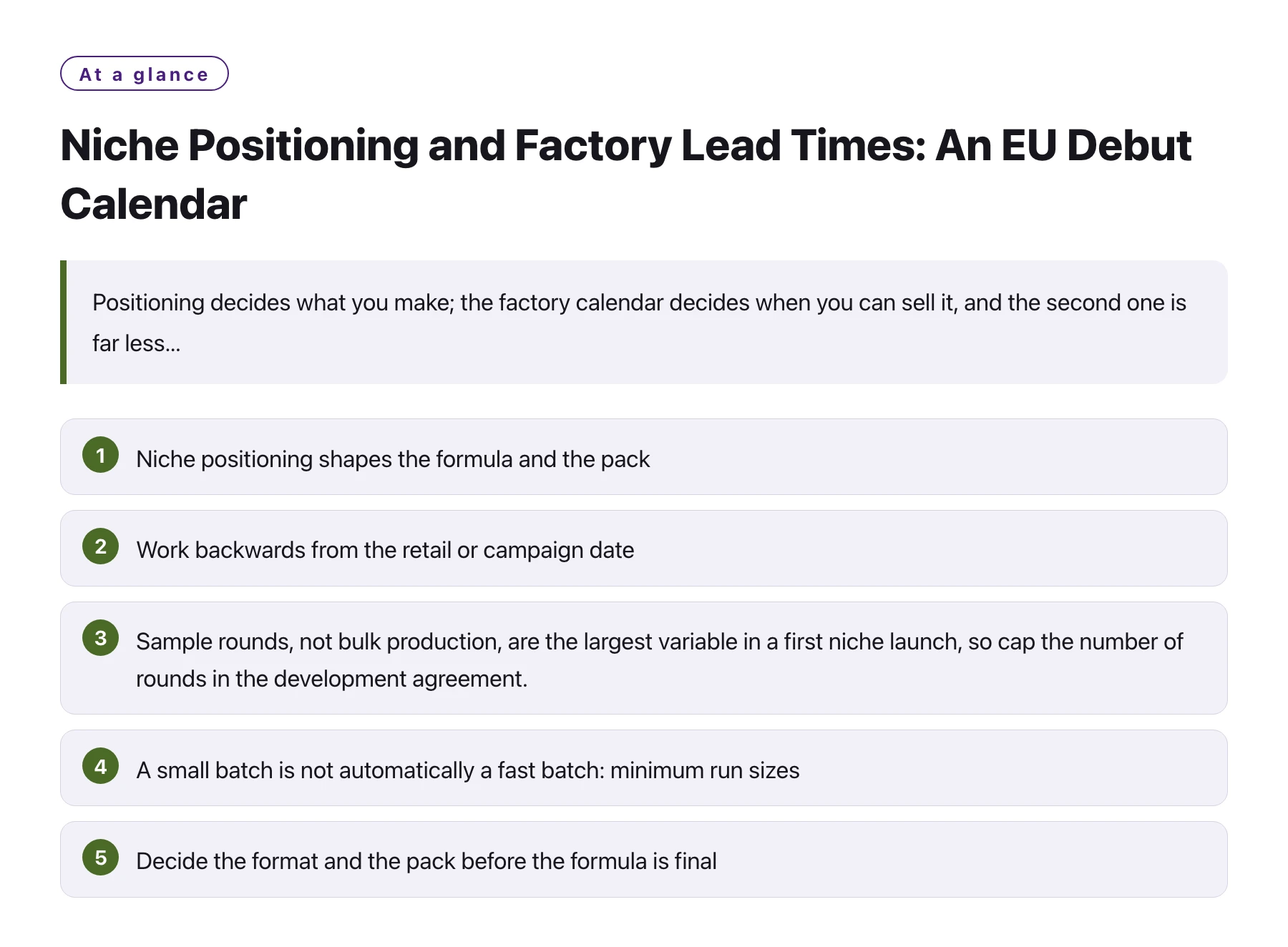
- Niche positioning shapes the formula and the pack, but it does not shorten the production, testing or freight weeks that sit between approval and shelf.
- Work backwards from the retail or campaign date, then place the compliance milestones before the artwork freeze, because label changes are the most expensive kind of delay.
- Sample rounds, not bulk production, are the largest variable in a first niche launch, so cap the number of rounds in the development agreement.
- A small batch is not automatically a fast batch: minimum run sizes, glass availability and decoration queues can each add weeks for an independent brand.
- Decide the format and the pack before the formula is final, since compatibility and stability testing are pack-specific.
- The most reliable schedule protection is one named contact at the factory who owns dates in writing.
Independent fragrance brands tend to arrive at manufacturing with a strong point of view and a weak calendar. The point of view is an advantage: it makes the brief specific and the sample conversation productive. The calendar is where first launches are lost, usually not because a factory was slow but because a decision that had to be made in month two was made in month five.
This walkthrough is written for a founder preparing a first EU-bound range, most likely with three to six scents rather than thirty. It assumes a limited budget, a fixed launch window such as a trade fair, a seasonal drop or a retail reset, and no in-house production experience.
The calendar below is expressed in relative weeks rather than fixed dates, because the real duration depends on the pack, the market and the time of year. What transfers from project to project is the order of the milestones and which of them can move without moving everything else.
The sequence, counted backwards from the ship date
- Week minus twenty: lock the range and the briefDecide how many scents, which formats and which price tier. Every scent added later restarts sampling for that scent and consumes review time across the whole range.
- Week minus eighteen: brief and first sample roundSend one written brief per direction with reference products and a clear statement of what must not appear. A perfumer can work from three good references; ten references produce a blur.
- Week minus fifteen: select directions and freeze the pack shortlistChoose one direction per scent to develop and, in parallel, shortlist two pack options. Pack lead times are the most common hidden constraint for a small brand.
- Week minus twelve: second sample round and pack decisionApprove the scent against a retained reference and commit to the pack, because stability and compatibility testing are run in the final container.
- Week minus ten: compliance and artwork milestonesCommission or receive the assessment inputs, confirm allergen wording and freeze artwork only after the labelling documents are in hand.
- Week minus eight: bulk production and fillingBulk is scheduled, filled and packed. Ask for the batch plan date in writing rather than a range, and ask what would move it.
- Week minus four: quality release and freightBatch documentation is issued, cartons are finished and goods move. Ocean freight needs a wider buffer than air, and the buffer should be visible in the plan rather than assumed.
Where the weeks actually go
| Stage | What the calendar really depends on | How a niche brand can protect it |
|---|---|---|
| Sampling rounds | How clearly the brief was written and how fast feedback returns | Cap the rounds in the agreement and give feedback within three working days |
| Pack sourcing | Whether the glass, cap and pump are stock items or new moulds | Choose stock components for the first run and save custom tooling for the second |
| Stability and compatibility | Whether the final pack was decided before testing began | Freeze the pack at the same time as the scent direction, not after |
| Compliance inputs | How quickly the formula specification is finalised and who needs to read it | Name the responsible person early and send them the specification as soon as it is versioned |
| Decoration | Printing, foiling or coating queues at the decorator | Ask for the decoration slot date before the bulk date is confirmed |
| Freight and customs | Mode, season and completeness of the paperwork | Book freight once the batch date is fixed and keep the documents with the shipment |
Read the middle column as the list of things a founder can influence. The right-hand column is the habit that keeps each one from consuming the buffer.
Why niche positioning does not shorten the queue
For indie perfume brands, the advantage is usually a point of view, a smaller range and a story that a larger house cannot tell as convincingly. None of those advantages reduce the physics of production. The concentrate still has to be compounded, the batch still has to rest, the pack still has to be filled and tested, and the goods still have to clear the same rules as any other cosmetic product entering the European market.
Where positioning does help is in the number of decisions. A tightly defined range means fewer directions to evaluate, fewer packs to qualify and a shorter review cycle. A founder who resists adding a seventh scent at week minus ten is protecting two weeks of sampling and one round of stability testing.
It also helps to know which regulatory questions follow the product type rather than the size of the brand. The European market overview is a reasonable first read for a founder who has not placed a cosmetic product on the market before, and it makes the compliance conversation with a factory specific rather than abstract [1].
Finally, positioning affects the pack more than it affects the process. A refillable or unusually shaped bottle is a legitimate niche asset, but it adds tooling, testing and decoration time that a stock bottle does not. Treating that trade-off as a calendar decision rather than as a design decision is what keeps the launch window intact.
Questions that shorten the calendar before you sign
Ask how many sample rounds are included and what a further round costs in money and in days. Ask which parts of the calendar the factory controls directly and which it subcontracts. Ask what the last three first orders actually took, measured from approved sample to shipped goods, rather than what the standard lead time says.
Ask who will own your project internally. A named project contact with authority to schedule is worth more to a launch date than a lower unit price, and a a fragrance manufacturer with 31 years of experience has usually seen every version of a compressed calendar already. If a private label partner for perfume lines can describe its own handover points without prompting, it has run this sequence often enough to protect it. If you are still mapping the overall sequence for the first time, the steps behind a new fragrance brand is a useful frame to compare against your own plan.
Ask where the formula sits relative to the finished product. A house that develops and produces together can absorb a small change in one conversation; a route that separates development from filling will add a handover each time something moves. That difference rarely appears in a quotation, and it appears clearly in a calendar.
Material restrictions belong on the same list. Fragrance materials are governed by a standards programme with concentration limits that vary by product category, so a direction that depends on a restricted material may need a reformulation before it can be assessed for the European market [2]. Discovering that at week minus ten is the most avoidable delay in the whole plan.
One scheduling rule that pays for itself: never let two milestones share a week unless they are independent. Artwork approval and label printing, pack decision and stability testing, and bulk release and freight booking are each a chain of two. Compressing them does not save a week; it moves the risk to the end of the project, where it costs the most.
Sources
- European Commission: Cosmetics in the EU —— The European Commission's overview of EU cosmetics rules, including the responsible person, product information file and safety report requirements.
- IFRA Standards Library (International Fragrance Association) —— The IFRA Standards Library lists the restrictions the fragrance industry applies to individual fragrance ingredients, based on safety assessments; it is the reference point for compliant fragrance formulation.
Frequently asked questions
How long does a first niche fragrance order take from brief to shelf?
For a stock pack and a three to six scent range sold into the EU, sixteen to twenty weeks is a realistic working figure, with freight on top. Custom tooling, complex decoration or a peak production season can extend it.
Can a small order be produced faster than a large one?
Only up to a point. A small batch may be scheduled quickly, but it still waits for materials, pack components and a slot in the filling line, and it can be displaced by larger runs during busy periods.
Should sampling and pack sourcing run at the same time?
Yes. They are independent until the final pack is chosen, and running them in parallel is one of the few ways to genuinely remove weeks from a first launch without shortening testing.
What most often breaks a niche launch calendar?
Late decisions rather than slow production. Adding a scent, changing a bottle or rewriting a claim after the milestones have passed each trigger a chain of rework that was not in the plan.
Do independent brands need the same compliance steps as larger ones?
The duties follow the product and the market, not the size of the company. A small range can be simpler to document, but the assessment, labelling and file-keeping steps still apply.